
News Technology
When the paint can feel
Robots are becoming more sensitive – and paint plays a central role in this. With laser-structured sensor layers and printed sensor films robot surfaces turn into active measuring systems.
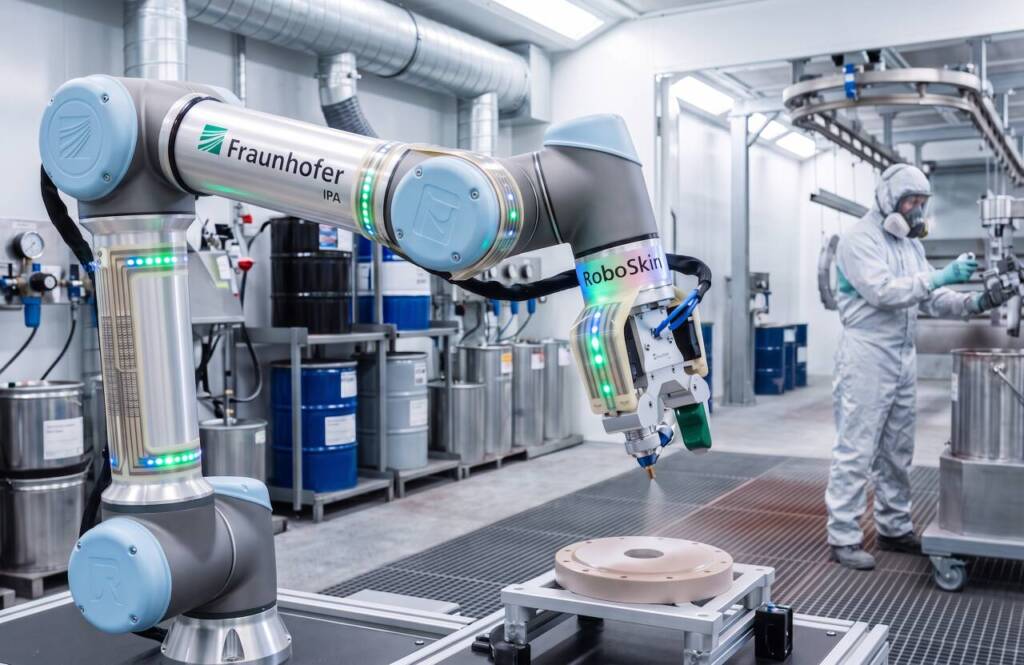
Collaborative robots, or cobots for short, are designed to support workers directly in production because they can be used flexibly and can work closer to humans than conventional industrial robots. For this cooperation to function without separating safety fences, cobots must reliably perceive their environment. Printed sensors and intelligent coatings could improve this by shifting the sensor technology directly onto the surface of robot arms, grippers or tools.
In the ‘RoboSkin’ and ‘RoboTattoo’ projects, two complementary technological approaches were investigated at Fraunhofer IPA together with partners: flexible, printed sensor films as well as conductive, laser-structurable paint layers. Both concepts pursue the same goal: cobots should be able to detect approaches, contacts or forces via large-area, thin and geometry-adapted sensor layers.
Painted sensors instead of additional hardware
The basic idea is simple and at the same time demanding: electrically conductive structures are applied to a film or directly to a component. These structures act as capacitive proximity sensors. When an object or a hand approaches, the electric field of the sensor surface changes. This change is evaluated electronically and can be used for obstacle detection, distance estimation or to trigger a stop signal.
This gives rise to new requirements for coating technology. The layers must be conductive, thin, flexible, adhesive and applicable with process reliability. In ‘RoboSkin’, printable polyester films, among other things, were investigated as carriers. They showed good wetting and adhesion for conductive coatings and achieved important mechanical target values with a film thickness of approximately 70 µm and a tensile strength of around 120 N/mm².
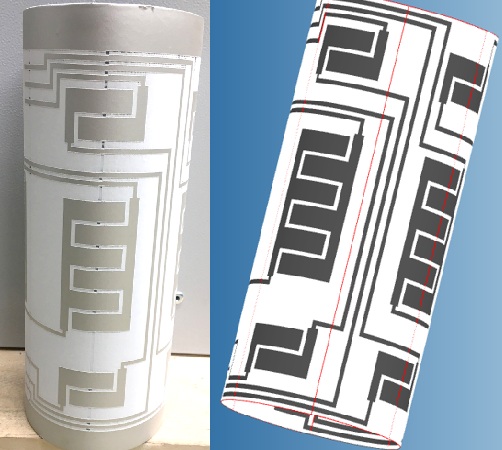
Fig. 1: Cylindrical physical sample with functional coating after electrode structuring by means of laser ablation - right - and layout for redundant sensor surfaces in the shell model - left (Photos: Fraunhofer IPA)
New design freedom
‘RoboTattoo’ consistently transfers this idea in the direction of intelligent paint layers. The technological core lies in electrically conductive coatings only a few micrometres thin, whose optical absorption is specifically matched to industrial laser processes. Sensor surfaces and conductor tracks are not created by separate film layouts or classic printing masks, but by precise laser ablation. This makes it possible to produce individual sensor structures on curved surfaces, for example on cylindrical robot arms, half shells or geometrically complex components (Fig. 1).
From sensor field to intelligent surface
For a functional coating to become an intelligent surface, a robust electronic and software architecture is required. Both projects showed: long analogue lines impair measurement quality, because they themselves become part of the electric field. Therefore, a modular concept with sensor boards close to the sensor surfaces was developed. The boards record the capacitance changes and transmit the data digitally to a central evaluation board.
The evaluation also determines performance. In ‘RoboSkin’, sensor data was combined with robot position data and AI-supported methods for distance estimation and object differentiation were investigated. In addition to proximity detection, pressure sensing was also implemented: a capacitive proximity sensor was combined with a compressible silicone layer, so that conclusions about the contact force could be drawn from the relative deformation.
Demonstrators show potential and limits
The demonstrators showed that integration on real robots is fundamentally possible. In ‘RoboSkin’, sensor films were applied to a Stäubli robot and its gripper. In ‘RoboTattoo’, a UR5 was equipped with laser-structured sensor shells (Fig. 2). When an object approached, the movement could be stopped and resumed after the obstacle was removed. In addition, the position of the detected approach was visualised.
At the same time, the tests showed some limits of the approach. Capacitive sensor technology reacts sensitively to environmental influences, temperature, humidity and the large earthed mass of an industrial robot. Thus, the projects provided important proofs of function, but not yet a fully certifiable safety solution.
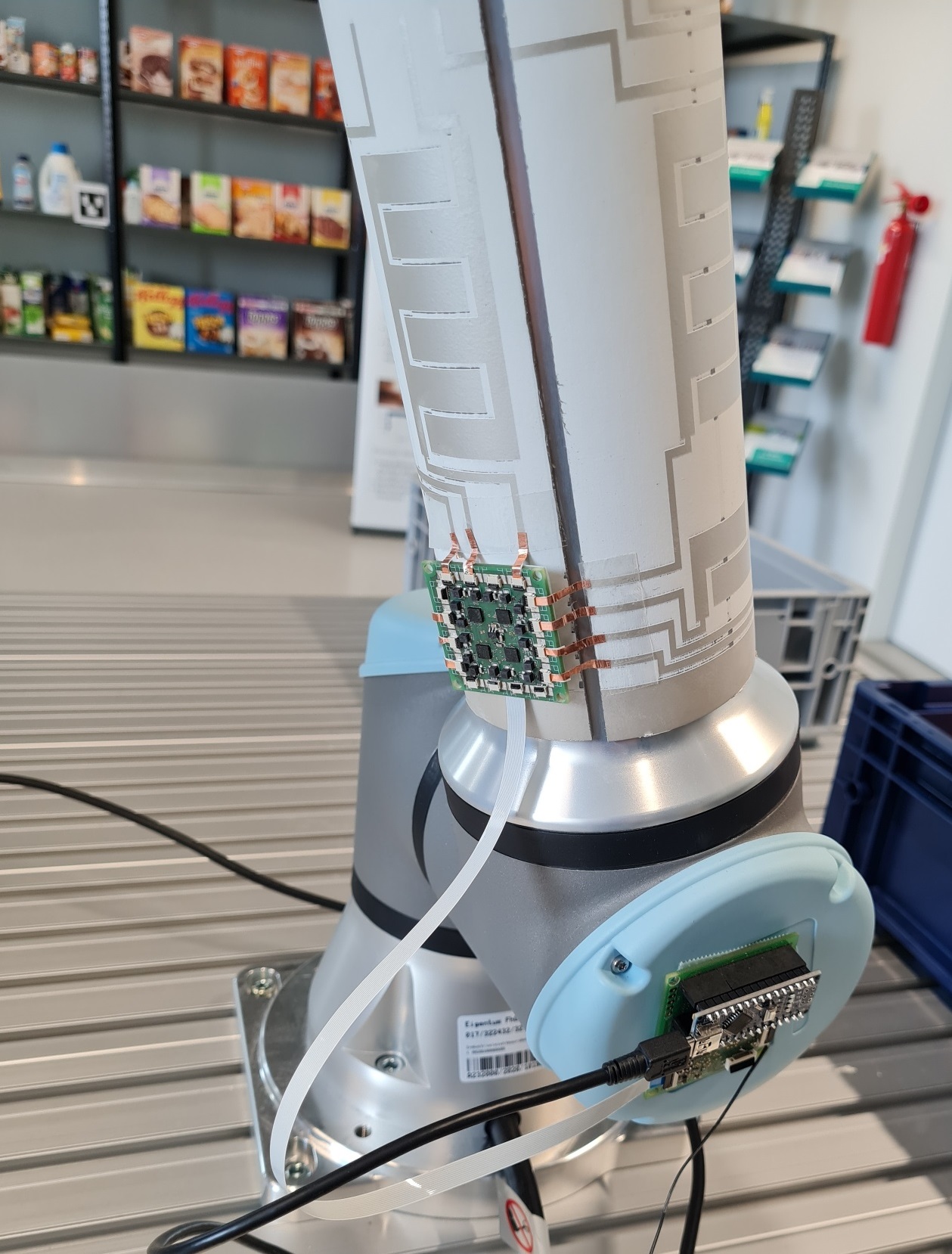
Fig. 2: Cuff with proximity sensors on UR5 including contacted electronics. (Picture: Fraunhofer IPA)
Relevant for painting and coating technology
The approach is very exciting for painting and coating technology. Coatings here take on not only protective, decorative or barrier functions, but also become active technical systems. Conductivity, laser absorption behaviour, adhesive strength, flexibility, water vapour permeability, contactability and protective layers must be considered together. This fundamentally shifts the role of paint.
More information: Fraunhofer Institute for Manufacturing Engineering and Automation IPA, Ivica Kolarić, ivica.kolaric@ipa.fraunhofer.de; www.ipa.fraunhofer.de