News Technology
Barrier Coatings to Address Hydrogen Embrittlement
Researchers at the spanish institute CIDETEC are developing barrier coatings intended to limit the interaction of hydrogen with metallic substrates used in storage and transport systems.
Hydrogen is expected to play a central role in the transition towards a more sustainable energy model. Its large-scale deployment, however, presents considerable technological challenges. Among these, hydrogen embrittlement stands out as a phenomenon that compromises the reliability and service life of metallic materials used in storage and transport systems. Addressing this issue is regarded as essential if hydrogen is to become a viable energy option from both a social and industrial perspective.
Against this background, CIDETEC Surface Engineering is contributing knowledge from the field of surface engineering through the ONTZHi-II project, which aims to advance key technologies for the storage, transport and distribution of hydrogen. Within the project, the research centre is focusing on the development of barrier coatings capable of limiting the interaction of hydrogen with the metallic substrates to which they are applied. Such coatings offer a route to protecting critical metallic materials and reducing the risks associated with prolonged exposure to hydrogen-rich environments.
Coating Development Guided by Hydrogen Behaviour
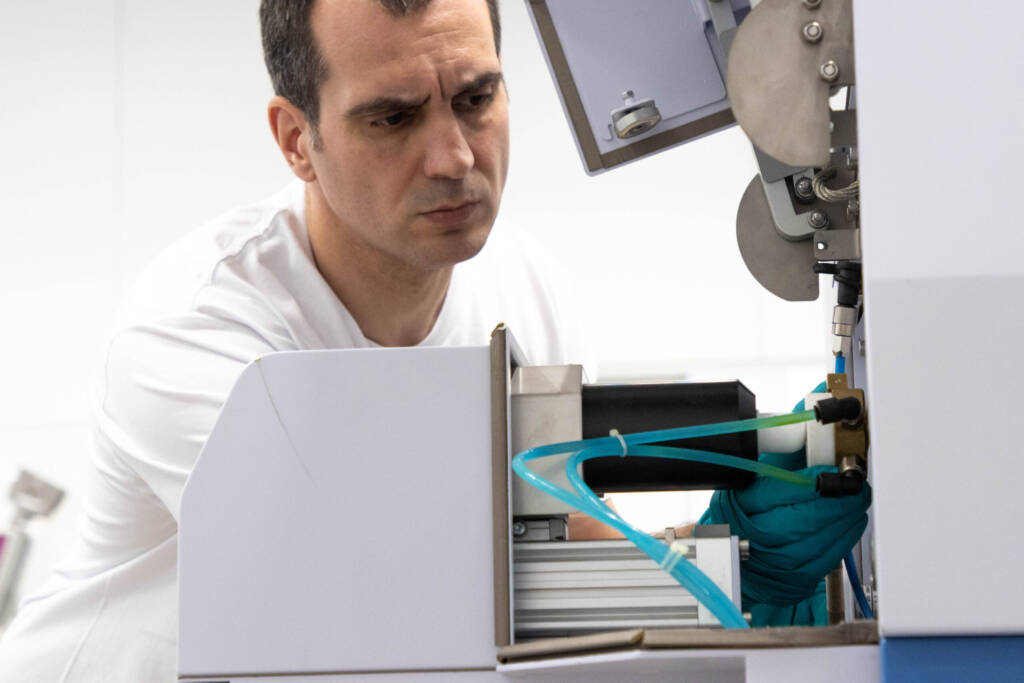
The design of these coatings is closely linked to an understanding of the mechanisms that govern hydrogen behaviour in materials. To support the development work, the coatings produced at CIDETEC are subjected to controlled hydrogen uptake conditions through electrochemical charging. The distribution of hydrogen from the surface into the interior of the material is then examined, providing information on the effectiveness of each coating variant and its ability to act as a barrier against the diffusion of this element.
For this purpose, the centre employs glow discharge optical emission spectroscopy (GD-OES), a method used to obtain elemental depth profiles, including profiles of hydrogen, an element that is difficult to detect by many other techniques. The results feed directly into the iterative development of the coating systems.
Combined Testing Approach
The spectroscopic analysis is complemented by hydrogen permeation testing using the Devanathan–Stachurski method. Together, the two techniques enable the research team to assess how hydrogen interacts with different coating formulations and architectures. During the second year of the project, this combined approach is being used to guide the development of more efficient and robust barrier coatings for hydrogen applications, with the aim of supporting the safe deployment of hydrogen technologies at industrial scale.
More information: www.surfaceengineering.cidetec.es
Stay updated: You want to stay up date on everything important in the global industrial coating industry? Then sign up for our free of charge Newsletter!