
Robotic Blasting for Greater Efficiency
To meet the growing demand for high-quality container refurbishment efficiently and economically, Muijs Containerreparatie has invested in a automated blasting system from Blastman Robotics. The goal of this investment was to increase productivity in the paint shop and quality while significantly improving occupational safety. Since commissioning the system, Muijs has increased its capacity from two to as many as 20 containers per day, all processed with consistent and reproducible quality.
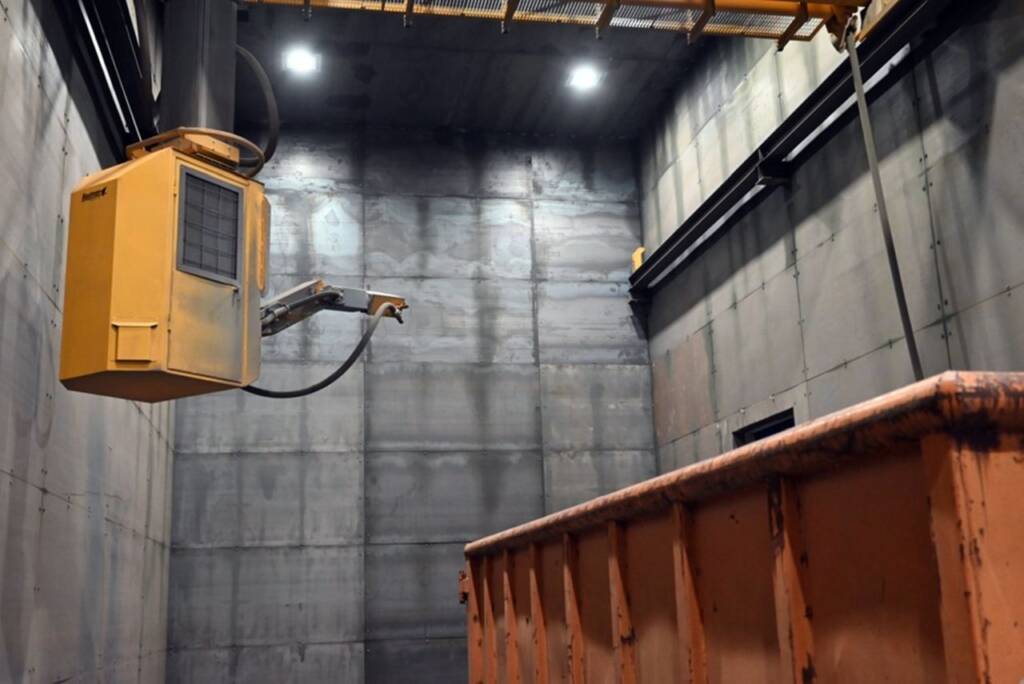
Muijs defined several core requirements for the new system: In addition to the ability to handle large quantities efficiently, the company placed particular emphasis on achieving consistent surface quality – meeting demanding standards such as Sa 2.5 and Sa 3. The system also needed to include a powerful dust extraction and abrasive recycling unit to ensure both ecological and economic operation. Full automation of the blasting process was intended not only to improve precision, but also to reduce the dependency on manual labor in the direct processing environment.
Before installing the robotic system, all blasting was carried out manually – a time-consuming, physically demanding process with inconsistent results. Today, a programmable robot handles the blasting: He can automatically adjust the blasting pressure, distance and blasting angle as well as the blasting media supply to the condition of the containers, thus ensuring a uniform result. The process begins with pre-cleaning, where dirt, stickers, and loose materials are removed. The container is then precisely positioned in the blasting chamber, and the parameters are optimized for the job. Steel grit is used as blasting media, offering excellent cleaning performance and up to 1,000 reuses – achieving the required surface profile while minimizing material use. “Integrating the robotic system into our workflow required detailed planning,” explains Leko Muijs, General Manager of the company. “One key challenge was adapting the system to process a variety of container types with different levels of contamination and structural complexity. Additionally, fine-tuning the blasting parameters for different coatings and surface conditions was essential to achieving optimal results.”
Blasting-Technology in Detail
The blasting chamber, including ventilation and abrasive recycling systems, was installed by Airblast, Blastman’s partner in the Netherlands. Blastman Robotics supplied and integrated the “B20CX” blasting robot, including the “BP1100” dual-chamber blast pot, and implemented the control system. The overall setup allows interruption-free blasting operations via automatic chamber switching – an important advantage in high-throughput environments.
The robot offers maximum flexibility. In manual manipulator mode, it can be operated directly from the cabin using joysticks to treat custom or single parts. In automated mode, it processes standard containers with consistent geometry. Programming can be done via Online Movement Recording, Point-to-Point programming with a hand device, or offline on a PC using “Blastman Studio”. This flexible system enables Muijs to handle both individual units and high-volume production reliably and efficiently.
From Damaged to Durable
Containers often arrive in severely deteriorated condition, with old coatings, corrosion, and industrial residues. Structural damage such as bent frames, cracked panels, and damaged locking systems is also common. Each unit undergoes a comprehensive incoming inspection, including a visual assessment, mechanical check of doors and frames, and surface contamination analysis to determine the appropriate blasting intensity. Based on this, the team decides whether Sa 2.5 is sufficient or whether Sa 3 is required for critical coating applications. At the same time, they assess whether welding, reinforcement, or component replacement is needed, and which coating strategy will ensure durability.
Following blasting, most containers require structural repairs. These include reinforcement of frames, panel replacements, and restoration of mechanical and hydraulic components, especially in special-purpose containers. Muijs uses the MIG/MAG welding process, proven for load-bearing constructions. Because a wide variety of container types are processed, each repair requires flexible solutions that balance stability and precision. “The greatest challenge is preserving structural integrity while working efficiently,” says Muijs. “These containers are often heavily damaged. Our job is to make them not only functional again, but fully operational.”
Multi-step coating process
Once repairs are complete, a multi-step coating process begins in the paint shop. First, an epoxy-based corrosion protection primer is applied. This is followed by a durable polyurethane or acrylic topcoat, depending on requirements. Water-based coatings are also available for environmentally sensitive applications. Logos, serial numbers, and safety markings are then added. A final quality inspection includes thickness measurement, adhesion testing, and visual checks before the unit is released. The entire process – from delivery through blasting, repair, and coating – takes only a few working days, depending on container condition. Muijs also handles end-to-end logistics, either delivering the refurbished container back to the customer or making it available for pick-up on site.
Initial implementation brought some challenges particularly regarding dust accumulation, due to the advanced age and heavy contamination of many containers. These were quickly resolved by system adjustments. The close collaboration with Blastman Robotics proved crucial. “The response time is excellent,” says Muijs. “It feels like a team effort – you don’t just get answers, you get solutions.” The investment in the new blasting system has not only increased quality, throughput, and safety, but also set the course for future growth. A second coating booth is now in operation, a third is in planning, and a new company is being established to focus exclusively on blasting and coating metal structures. “Our new system runs reliably and works many hours,” Muijs concludes. “We’re convinced that automation was the right decision – for our customers, our team, and the future of the business.”