
News Market
ACE-coating market in transition
The industrial coating of agricultural, construction, and earth-moving machinery is at a turning point. Increasing demands for sustainability, efficiency, and customization are colliding with outdated technical equipment, personnel shortages, and uncertain investment conditions.
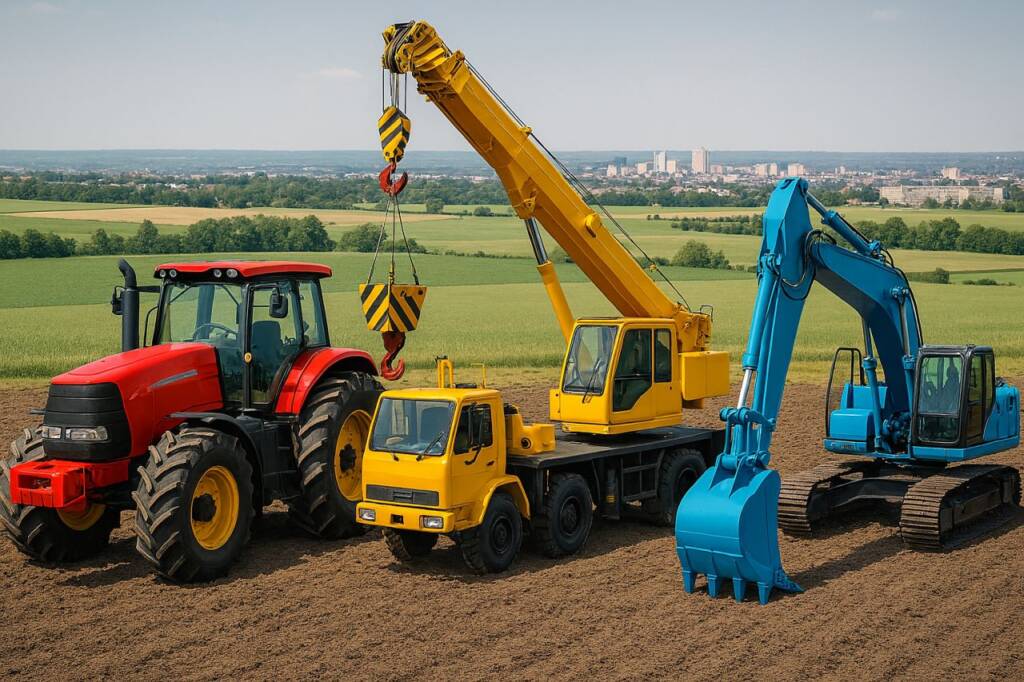
A recent user survey conducted as part of a specialist conference on ACE-Coatings (Arcricultural, Construktion & Earthmoving) shows where the industry stands – and what drives it. Five key areas emerged: The challenges facing the ACE industry mirror those of the industrial coating sector as a whole – with industry-specific nuances.
Hardly any other industry has to coat such a wide variety of components as the ACE industry. Large geometries, changing surfaces, and varying throughput quantities make standard solutions impossible. The survey participants were clear in their response: retrofitting is part of everyday life, while completely new systems are the exception. The measures are as individual as the components themselves – they range from individual color change programs to the renewal of entire drying zones. However, it is particularly clear in the field of conveyor technology that existing systems often cannot keep pace with the variety of variants. Downtimes due to manual part positioning or a lack of flexibility in component handling were frequently cited as bottlenecks. A fully automated ACE line remains the exception – despite the increasing degree of digitalization. The use of intelligent systems is still the exception in the ACE industry – potential is recognized, but rarely implemented. The conclusion: Every retrofit is custom work – and requires not only technology but also a deep understanding of the process.
Robust ACE-coatings-solutions instead of high-gloss systems
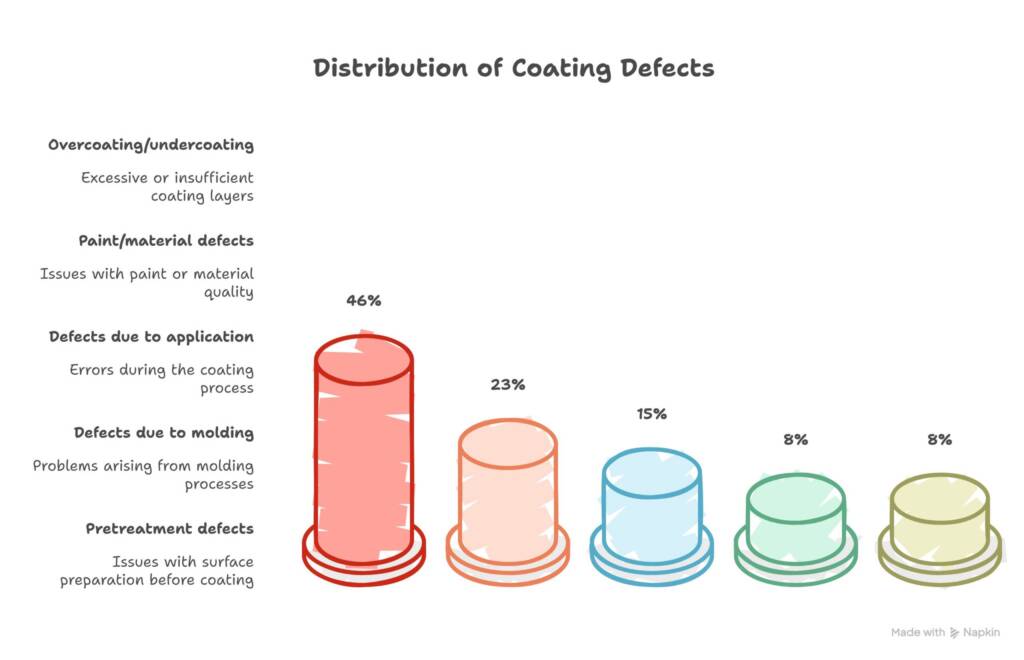
Compared to other industries, ACE coating focuses not only on a flawless appearance, but above all on robustness, process reliability, and durability. Accordingly, the survey shows that there is a demand for forgiving systems with a wide process window that function reliably even under changing conditions—for example, in shift operation, with temperature fluctuations, or with complex geometries. The fact that overcoating and undercoating account for 46% of defects underscores the complexity of ACE products: slanted edges, angled substrates, different material composites—all of these factors make uniform coating thickness control a challenge. Here, too, the conclusion is clear: less complexity in process control, more tolerance in the coating system.
Variety is the norm in ACE coating—it is rare for an order to be repeated with exactly the same color composition. This is clearly reflected in the survey results: small batches, frequent color changes, long setup times—all of these factors have a negative impact on profitability. 55% of participants see automation and flexibility in application technology as the biggest challenge. Compared to highly standardized industries, such as automotive supply, ACE color supply is far more dynamic – but also more prone to disruption. Seamless automation is currently hardly economically feasible. Instead, hybrid concepts combining digital control and manual flexibility dominate.
Pre-treatment – the Achilles heel of construction machinery coatings
Whether it’s a cab frame, attachment, or hydraulic carrier, the quality of the ACE coating depends on the pretreatment. 67% of survey participants cited insufficient degreasing as the main source of errors, especially for complex components with cavities, uneven surfaces, or variable contamination. Many companies rely on robust, simple processes, such as mechanical cleaning combined with standardized washing cycles. There is a high demand for automatic monitoring of temperature and chemicals, especially because the shortage of skilled workers makes knowledge transfer within the company difficult.
Hardly any other industry paints as many large-volume steel parts as the ACE sector – and the energy requirements are correspondingly high. At the same time, many companies have long been monitoring the carbon footprint of their painting processes: optimized application technology (59%), reusable covering materials (41%), and reduction of paint layer thickness are concrete measures that are already being implemented. However, bureaucracy is a major obstacle: 32% of those surveyed feel that funding conditions, reporting requirements, or approval procedures are slowing down the implementation of savings measures. Medium-sized companies in particular are not failing here because of technology, but because of the administrative burden.
Conclusion: A reflection of the market
The survey’s findings extend beyond the ACE industry. The challenges identified by paint shop managers here are similar to those faced by the furniture, metal, plastics, and automotive coating industries: retrofitting instead of new construction, a shortage of skilled workers instead of an AI offensive, resource conservation under certain conditions, and application in sync with variants. But it is particularly clear in the ACE industry what will be important in the future: process robustness, reduced complexity, and realistic automation scenarios. The future does not lie in one disruptive solution, but in the interaction of many pragmatic improvements along the entire chain. The good news is that the know-how is there, and so is the will to change.
SAVE THE DATE: ACC 2026 – International ACE-Coating-Conference
Following the successful national conference, the next step will take place in 2026: In June 2026, the ACE Coaching Conference – ACC for short – will be held in Ibbenbüren at GTS (Krone). This international trade event is aimed at decision-makers, production managers, and technical experts from the agricultural, construction, and earthmoving machinery coating sectors. The focus will be on digital strategies, innovative application and pretreatment processes, and forward-looking approaches to quality, efficiency, and sustainability.
Save the date – more information will follow shortly.