
News Technology
Automated cell for surface finishing launched
The Swiss-Swedish automation ABB Robotics has launched a turnkey sanding and polishing cell aimed at small and medium-sized manufacturers seeking to automate surface finishing without in-house robotics expertise.
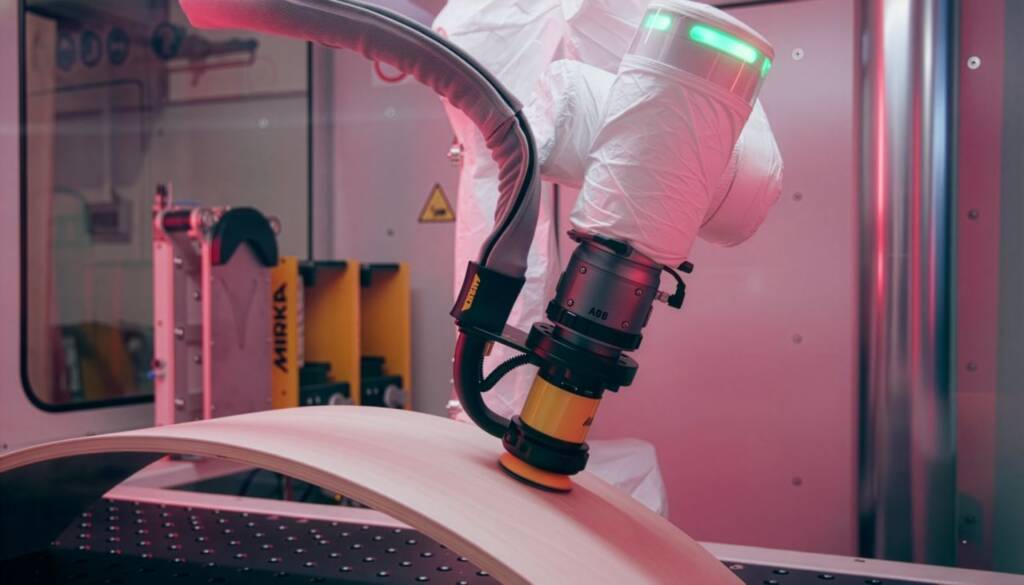
ABB Robotics has brought its first fully automated sanding and polishing cell to the market. The OmniVance Collaborative Surface Finishing Cell is intended to give small and medium-sized manufacturing operations the means to automate core tasks in surface finishing, an area that has traditionally been difficult to address with standard automation packages.
According to the company, demand for automation of tasks such as grinding and polishing is rising, while many smaller operations lack their own robotics know-how. “Many companies are reluctant to invest in complex, customised automation solutions. At the same time, common standard solutions often lack the necessary flexibility and performance,” says Craig McDonnell, Head of the Business Line Industries at ABB Robotics. With the new cell, the company aims to position industrial robotics as a scalable option for this user group.
Closing a gap between custom and entry-level systems
Surface finishing is a decisive manufacturing step in practically every industry. However, more complex production requirements and a shortage of skilled labour are placing additional pressure on operators. Deloitte and the Manufacturing Institute estimate that 1.9 million positions in the manufacturing industry will remain unfilled by 2033.
The new system is designed as a turnkey offering that bridges the gap between bespoke automation and standard entry-level packages. It uses a collaborative GoFa robot to carry out surface finishing tasks without the need for in-depth robotics expertise.
The cell is delivered as a ready-to-operate plug-and-play package, including the cobot and all safety components. It is CE-certified and requires no additional technical modifications before commissioning. New tools and accessories can be retrofitted, which is intended to be useful where a large number of product variants must be processed.
Dust extraction and operator relief
By automating repetitive grinding and polishing tasks, the new solution is designed to increase throughput while reducing scrap and rework. An integrated dust extraction system is intended to contribute to a cleaner working environment and to the quality of the finished parts. Skilled workers are relieved of monotonous tasks and can concentrate on higher-value activities.
The cell is operated via a tablet-style user interface developed to control the entire finishing process. Functions such as 3D path recording, the setting of preconfigured 2D paths and intuitive path editing are integrated as programming blocks within the “Wizard Easy Programming” software. According to ABB, this can reduce programming time by up to 90 percent compared with conventional approaches, and does not require dedicated robotics programming skills.
The cell complies with the EU Machinery Directive and is supplied with the declaration of conformity required for EU markets.
More information: www.abb.com/robotics
You want to stay up date on everything in the gloabl industrial coating industry? Then sign up for our free of charge Newsletter!