News Technology
AI-supported robot programming lowers entry barriers
ABB Robotics integrates an AI assistant into its “RobotStudio” Suite, an offline programming and simulation software, which supports users in creating and optimizing painting programs through prompt-based communication – without losing human control.
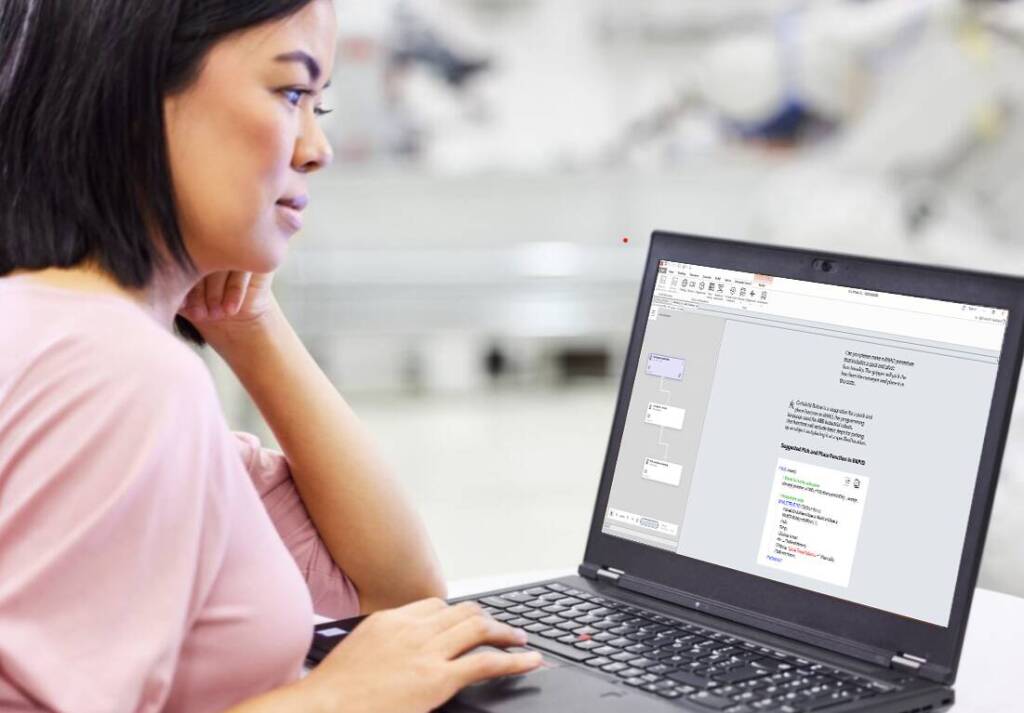
For a long time, programming painting robots was considered the domain of highly specialized experts with decades of experience. Anyone who wanted to set up a robot for a new task had to stand in front of a teach panel and move the robot arm manually from position to position – while the system was at a standstill and not producing any parts. According to Magnus Seger, Global Product Manager Simulation Software at ABB Robotics, RobotStudio offline programming has fundamentally changed this situation: “You can prepare everything virtually before you actually start production. This means that you can create and verify the program virtually, test the cycle time and, in painting applications, for example, check whether the surface is completely covered.”
Despite these advances, the actual programming remained challenging: adding logic, writing code and understanding complex program structures still required in-depth expertise.
Virtual controller as a basis of trust
According to ABB, a key factor in the reliability of offline programming is the virtual controller, which the company describes as a unique selling point. This virtual controller is identical to the real controller that runs in the production plant. Seger explains: “This means that everything you do virtually delivers exactly the same result. The movement times, the path profiles, the behavior – and, interestingly, you even see the same errors virtually as you would in reality.”
According to Seger, the visibility of errors in the virtual environment offers considerable advantages. While programmers on the shop floor are under time pressure and must fix problems as quickly as possible, they can take time to analyze them in the virtual environment and develop optimal solutions.
Prompt-based interaction instead of code
With the integration of an AI assistant, ABB is now going one step further. Instead of writing code manually or navigating complex menu structures, users can formulate their requirements in natural language. The AI assistant understands instructions such as ‘please open module 1 in the system’ or ‘explain this program to me’ and implements them accordingly.
The key thing is that humans remain in control. The AI assistant suggests changes, shows exactly which lines of code are to be added or modified, and waits for the user’s confirmation. “The AI doesn’t just introduce code,” emphasises Seger. “You are in the driver’s seat. You have to say: Yes, I’ll apply that, it works.” Only after approval do the changes take effect – and can then be tested in the simulation before being transferred to the real robot.
Technical safeguards against hallucinations
According to ABB, the technical basis of the AI assistant is the Azure OpenAI model, currently in version 4.2 with a planned upgrade to version 5.0. To improve the quality of responses for specific use cases, ABB relies on RAG (Retrieval Augmented Generation) technology. This involves integrating the company’s own data sources, such as documentation, manuals, and forum entries, into the system. With each software release, the system is further trained and improved, according to Seger.
Particular attention is paid to avoiding hallucinations – i.e. invented or incorrect answers from the AI. Seger explains: “We have set the parameters to zero so that the system does not invent anything. In normal prompt-based chatting, these parameters are quite high, but we have lowered them.” If the system cannot find a solution, it informs the user instead of generating a potentially incorrect answer.
Target group: Beginners and experts alike
According to ABB, the AI assistant is part of the standard RobotStudio product and is available to all users with a premium subscription. The target group includes both beginners and experienced programmers. While newcomers benefit from guided support and the barrier to entry into robot programming is lowered, experts can also use the system to work more efficiently or identify potential for optimization.
It is interesting to note that even skeptical programmers with decades of experience would accept the system after initial trials, reports Seger: “People were naturally a little skeptical. But after using it for a short time, that disappeared.” The multilingualism of the system – users can prompt in their respective national languages – lowers additional barriers.
For smaller companies that previously shied away from the costs and training required for automation, simplified programming could open new opportunities. Industries that have been less automated due to lower production volumes, or contract painters with frequently changing workpieces, can benefit from lower entry barriers.
Working towards even greater integration
The long-term vision goes beyond the current support. Seger outlines a future in which robots act more autonomously through the combination of sensors and AI: “In the future, we will no longer have to write the code perfectly. Later, sensors combined with AI and the ability to see, touch and feel will mean that it will no longer be necessary to specify the entire painting process.” The robot would then have more freedom to make its own decisions, based on input signals.
The plan is for production data to feedback from the shop floor into the system, so communication becomes a two-way thing. PixelPaint technology, in which robots apply individual designs to surfaces, is not yet integrated into AI support – although, according to Seger, the combination of image generation and AI would be “a perfect match.”
In addition to the pure increase in efficiency, Seger emphasizes another aspect: “It’s not just about being faster. Sometimes it’s about achieving better quality.” AI can help identify bottlenecks and optimize solutions – an added value that is more difficult to quantify in percentages.
The company offers a 30 day free of charge trial for RobotStudio.
More information: www.abb.com/robotics